miDose Solutions at EGU General Assembly 2024!

miDose Solutions at EGU General Assembly 2024!

We are excited to announce a significant milestone for miDose Solutions! For the first time, we will participate in the European Geosciences Union General Assembly, taking place in Vienna from April 14th to 19th, 2024. This event is set to bring together experts and enthusiasts from across the geosciences spectrum.

At miDose Solutions, our commitment is to provide the geosciences community with tools and systems that are absolutely essential for their work. We are eager to introduce attendees to our flagship μDOSE+ system.

But our ambitions don’t stop there. We are also poised to unveil a brand-new, fully automatic C-14 graphitization system to further facilitate researchers and the dating community.

We cordially invite all attendees to join us at booth number 103 in the Exhibition Gallery at the Green Level (first floor), where you can see and touch our products firsthand. Our dedicated team will be there to discuss our products and their potential applications. We are looking forward to connecting with you in person, sharing our insights, and discussing how miDose Solutions can contribute to your scientific pursuits and projects.

We will be available from Monday, April 15th, to Thursday, April 18th, 2024, daily from 10:00 to 18:00, and on Friday, April 19th, 2024, from 10:00 to 13:00. Mark your calendars and make sure to visit us in Vienna. See you at the EGU General Assembly 2024!
New Study Unravels Middle Bronze Age Farming Techniques in Germany’s Western Allgäu

New Study Unravels Middle Bronze Age Farming Techniques in Germany’s Western Allgäu

A recent study has provided fascinating insights into the subsistence farming practices of the Middle Bronze Age (MBA) in SW-Germany’s Western Allgäu region. Utilizing a multidisciplinary approach, the research team combined archaeological evidence with sedimentary and biogeochemical analysis to reconstruct the ancient farming activities in this historically significant area.

The research focused on multi-layered colluvial and alluvial deposits near MBA settlements. These deposits were dated using optically stimulated luminescence (OSL) techniques and AMS radiocarbon measurements of charcoal, providing a detailed chronostratigraphic framework. The study revealed phases of deposition and land use during the MBA, correlating with recently excavated inland settlements in the region.  Multi-proxy investigations helped in reconstructing the subsistence farming practices of the era.

The results showed that the MBA economy in Western Allgäu was extensive and diversified. This reflects an adaptation of the MBA farmers to the harsh climatic conditions of the region, where crop yields were less predictable compared to other areas like near Lake Constance. The accumulation of charcoal and PAHs in MBA-related colluvial horizons is most likely associated with the use of fire to maintain an open landscape. Additionally, increased urease activity and the appearance of Juniperus indicate the importance of livestock farming within the MBA subsistence.

This study offers new perspectives on the subsistence strategies of MBA societies in agriculturally less favorable areas, providing a comprehensive understanding of ancient agricultural practices in the northern Alpine foreland. The findings have significant implications for our knowledge of Bronze Age farming and settlement patterns in the region.

References: 

Scherer, S., Höpfer, B., Deckers, K., Fuchs, M., Kandeler, E., Lehndorff, E., Lomax, J., Marhan, S., Poll, C., Wroth, K., Knopf, T., Scholten, T., Kühn, P., 2023. Archaeopedological reconstruction of Middle Bronze Age subsistence farming in SW-Germany from sedimentary archives in the Western Allgäu. Geoderma Regional (35). https://doi.org/10.1016/j.geodrs.2023.e00715

New Insights into Historical Mining Activities in Tarnowskie Góry, Poland

New Insights into Historical Mining Activities in Tarnowskie Góry, Poland

A recent study has provided fresh details on the historical mining activities in Tarnowskie Góry, Poland, dating back to as early as the 10th century. Researchers used a combination of Accelerator Mass Spectrometry (AMS), Optically Stimulated Luminescence (OSL), and dendrochronology to determine the age of mining shaft remains in the post-exploitation field of this region known for its lead ore and silver extraction from the 12th to the 20th centuries.

The AMS method yielded 12 results, with the majority of the dates ranging from 1435 to 1645 cal AD, aligning with the most intense mining period in the 16th century. However, two results pointed to significantly older periods, suggesting earlier mining activities potentially dating back to the beginnings of the Polish State. Dendrochronological analysis of construction wood found in the mines corroborated these radiocarbon dates.

OSL dating, on the other hand, provided much older dates ranging from 2.5 ka BP to 216 ka BP. These results were considered overestimated due to probable issues with the luminescence signal not being reset during sediment redeposition. Despite this, the quality of the luminescence signal was reported as satisfactory.

References:

Pawełczyk, F., Bolik, A., Błachut, B., Kamińska, A., Opała-Owczarek, M., Malik, I., Wojcik, M., Zakrzewska, Z., Pawlak, Z., Poręba, G., 2023. Development of Chronology for Historical Mining Shaft Remains in the Vicinity of Tarnowskie Góry Based on Radiocarbon, Luminescence and Dendrochronological Dating. Geochronometria (50). https://doi.org/10.2478/geochr-2023-0004

New Method Speeds Up Dating of Thar Desert Dunes

New Method Speeds Up Dating of Thar Desert Dunes

In a recent study, Nitundil et al. (2023) are exploring the potential of an innovative technique to rapidly estimate the age of dunes in India’s Thar Desert, significantly speeding up the process. The study primarily utilized a portable optically stimulated luminescence (POSL) reader, drastically reducing the analysis time to around 5 minutes per sample.

The findings indicate an eastward movement of the dunes, with the eastern sides being younger and accumulating sand at a faster rate. This new method not only provides a faster way to study the desert’s shifting landscape but also offers insights into environmental changes over time.

Additionally, the article mentions a comparison between the results obtained from the μDose system and the traditional Inductively Coupled Plasma Mass Spectrometry (ICP-MS). The two methods showed consistency within the margin of uncertainty, validating the reliability of the μDose system in supporting the POSL reader for rapid age assessments.

This innovative approach is set to transform the way researchers study and understand desert dynamics, providing a quick, reliable, and accessible means to track and predict changes in sensitive environments like the Thar Desert.

References:

Nitundil, S., Stone, A., Srivastava, A., 2023. Applicability of using portable luminescence reader for rapid age-assessments of dune accumulation in the Thar desert, India. Quaternary Geochronology (78). https://doi.org/10.1016/j.quageo.2023.101468

μDOSE System for Hazard Indices Estimation

μDOSE System for Hazard Indices Estimation

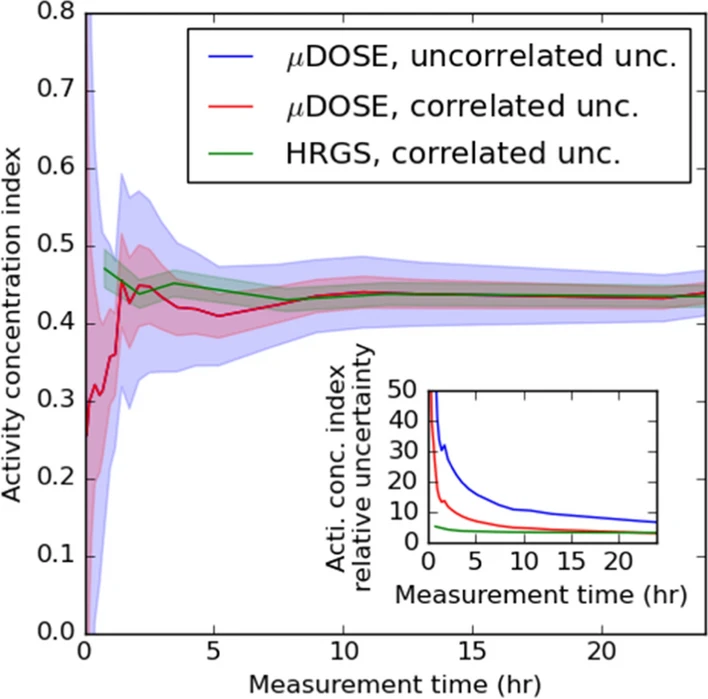
A recent publication by Rocznik et al. (2023) demonstrated the μDOSE’s capability in accurately estimating various hazard indices (HI), including activity concentration index, radium equivalent activity, representative level index, absorbed and annual gamma dose rates, gamma effective indices, and both external and internal radiation hazard indices. This research highlights the new possibilities offered by the μDOSE system, particularly in measuring HI in small samples of just 3.00 grams. The estimation of HI was based on α and β particles, as well as decay pairs of 220Rn/216Po, 219Rn/215Po, 212Bi/212Po, and 214Bi/214Po. This method provided correlated radionuclide estimates. By taking this correlation into account, HI can be calculated with increased precision. The hazard indices measured were then compared with the results from high-resolution gamma spectrometry.

Activity concentration index value uncertainty as a function of measurement time for HRGS (100 g samples) and μDOSE system (3.00 g samples) (from Rocznik et al., 2023)

References:

Rocznik, J., Pluta, J., Tudyka, K., Poręba, G., Szymak, A., 2023. A new fast screening method for estimating building materials hazard indices with correlated inputs. J Radioanal Nucl Chem. https://doi.org/10.1007/s10967-023-09197-5

miDose Solutions at the DLED2023 Conference in Innsbruck!

miDose Solutions at the DLED2023 Conference in Innsbruck!

INNSBRUCK, Austria: From November 9-11, the University of Innsbruck will host the prestigious luminescence and electron spin resonance dating conference DLED2023. miDose Solutions has confirmed its attendance.

At the forefront of our showcase is the enhanced μDOSE+ system for extra small samples. 

This important event brings together experts and scientists in the fields of luminescence and ESR. This is an excellent opportunity for us to present our revolutionary system – μDOSE.

See you in Innsbruck!

miDose Solutions at NUTECH2023 in Kraków!

miDose Solutions at NUTECH2023 in Kraków!

We’re thrilled to announce that miDose Solutions will be participating in the prestigious International Conference on Development and Applications of Nuclear Technologies – NUTECH2023. This landmark event is set to unfold in the historic heart of Kraków from September 20th to 22nd.

For us, NUTECH2023 is not merely a gathering but an exceptional opportunity to demonstrate the enhanced measurement capabilities of our μDOSE and μDOSE+ systems and introduce our latest innovations.

If cutting-edge low-level environmental radionuclide detection is in your interest, our booth at NUTECH2023 is the place to be.

We’re eagerly looking forward to engaging with professionals, exchanging insights, and learning from peers. See you in Kraków!

The μDOSE+ System is finally available

The μDOSE+ System is finally available

We’re thrilled to introduce our latest product – the μDOSE+ System.

This advanced, compact system is designed for high-precision assessment of ionising radiation’s dose rate in sediment and ceramic samples. Our upgraded device comes equipped with a triple scintillator, enabling low level accurate measurements. Unlike other α and β counting systems, the scintillator can be reused extensively, offering practically cost-free maintenance.

The μDOSE+ not only maintains key features of the original μDOSE, but it also introduces active shielding, significantly reducing background counts. This is achieved through state-of-the-art machine learning algorithms, making our system more precise and reliable.

One of the unique features of μDOSE+ is the integrated active 222Rn and 220Rn removal system, ensuring a clean, radon-free environment for accurate measurements.

Key advantages of our system include:

  • Compact size: W 22 cm x L 22 cm x H 34 cm
  • Triple scintillator integrated with machine learning algorithms
  • Improved counting chamber that provides higher counting efficiency
  • Active 222Rn and 220Rn removal system
  • Measurement time is typically 1-2 days for assessing dose rate
  • Comprehensive software enables dose rate calculations under varying conditions
  • Offers both installation and assistance for smooth operation

miDose Solutions at LED2023!

miDose Solutions at LED2023!

We are pleased to announce an intriguing revelation! miDose Solutions will be participating in the 17th International Luminescence and Electron Spin Resonance Dating conference, also known as LED 2023. The conference is scheduled to take place from June 26th to June 30th, 2023, in Copenhagen, Denmark.

We are thrilled to have the opportunity to showcase our latest innovations and network with other experts in the field. The conference will cover a wide range of topics related to luminescence and electron spin resonance dating, including applications in geology, archaeology, and environmental science.

At miDose Solutions, we are committed to providing our customers with the most accurate and reliable environmental radionuclide and dose rate measuring systems. We are excited to share our knowledge and expertise with the attendees at LED 2023. Along with showcasing our latest innovations, we are eager to learn from other experts in the field and discover new ways to advance the science of luminescence dosimetry.

Furthermore, an air of mystery surrounds our presence at LED 2023, as we prepare to unveil a new product at the conference. This remarkable creation, shrouded in secrecy, holds the potential to improve dose rate measurements for luminescence dating. Stay tuned!

We invite all the attendees to visit our booth and learn more about our products and services. We are looking forward to meeting you in Copenhagen and discussing how we can support your research and scientific endeavors. See you soon!

Introducing μDOSE System at the 18th China Symposium on Luminescence and ESR Dating

Introducing μDOSE System at the 18th China Symposium on Luminescence and ESR Dating

We are proud to announce our presence in the prestigious scientific conference – the 18th China Symposium on Luminescence and Electron Spin Resonance Dating, taking place from May 8th to 11th at Yunnan University in Kunming, China!

This important event brings together experts and scientists in the fields of luminescence and ESR. This is an excellent opportunity for us to present our revolutionary system – μDOSE.

μDOSE is an innovative solution that significantly streamlines dating processes, utilizing advanced technologies and algorithms. Our system guarantees fast, accurate, and reliable dating results, making it an indispensable tool for scientists and experts involved in the analysis of the age of materials, artifacts, or fossils.

We are also excited to inform you that our sole agent in China, Beijing Cesmovy Science and Technology, will be present at the conference. Their presence will provide valuable support and representation for our μDOSE system in the Chinese market

At the conference, we will have the opportunity not only to showcase our system but also to establish collaborations with other participants and listen to inspiring presentations and discussions.

We cordially invite all interested parties to reach us at the 18th China Symposium on Luminescence and Electron Spin Resonance Dating, to learn more about μDOSE system and see how our solution can improve the way scientific research is conducted!

See you in Kunming City!